// creative analysis & storyboarding
Creative concepts, backed by data, generated by AI.
Production-ready storyboards with a clear reason for every hook, message and visual sequence.
See the creative evidence and the resulting storyboard in the interactive Foldwell demonstration.
// how the analysis works
Four inputs. One creative direction your team can make.
Campaign results and the ads themselves establish what happened. Competitor ads and trending formats broaden the creative possibilities. The output is a concept grounded in evidence, then a storyboard.
Campaign data
Spend, results, clicks, hook and hold.
Your creative content
Video, audio, frames, copy and message timing.
Competitor ads
Public hooks, formats, proof and sequences.
Trending formats
Current ways to tell the story, assessed for fit.
// linked evidence
Creative analysis
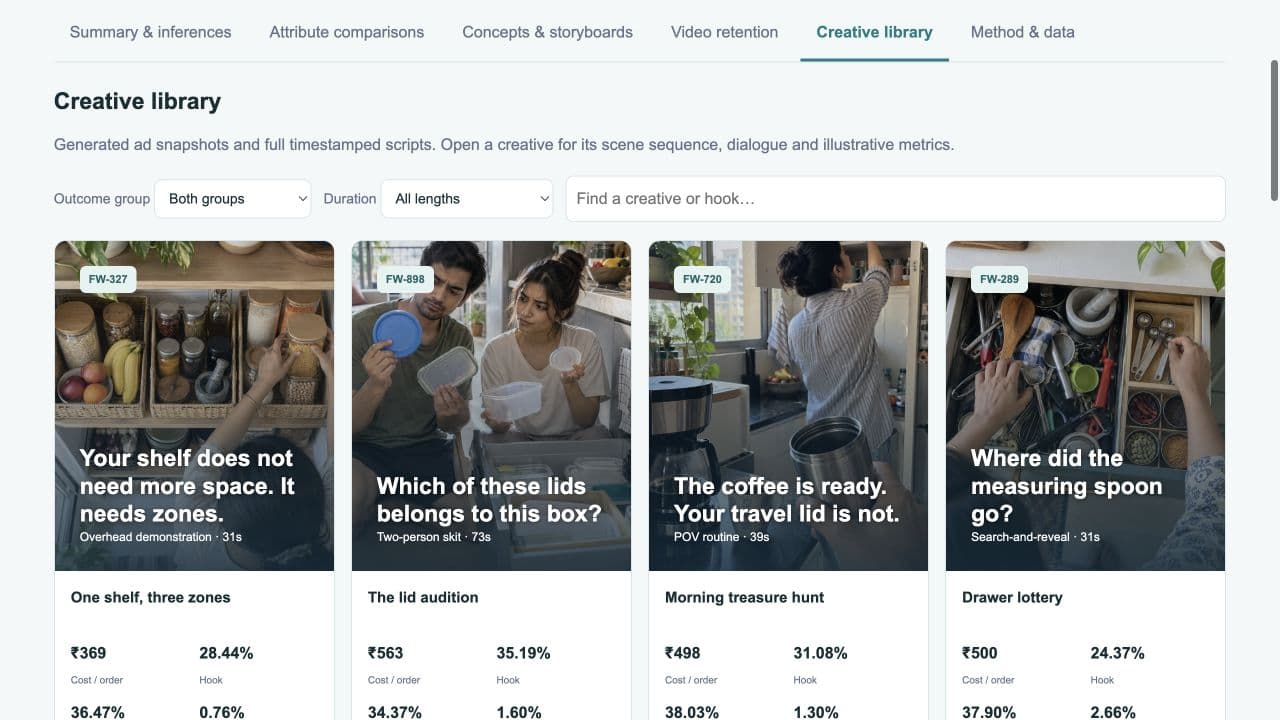
Match each ad to its performance context. Compare like with like, inspect what viewers see and hear, and separate observed results from inspiration.
Creative concepts
What to preserve, what to change and why.
Production-ready storyboards
Timed visuals, dialogue, proof, CTA and a controlled test.
Competitor ads do not reveal competitor CPA, CTR or ROAS. Competitor concept analysis is a planned capability. Public ads and trend references are creative inspiration; your own campaign data supports performance decisions.
// see the work
Watch the analysis become a storyboard.
The walkthrough moves from ad results and video evidence to attribute comparisons, concepts and a timed production brief.
Foldwell is a fictional brand. All creatives and performance figures in this demonstration are synthetic. Watch on Loom ↗
// inside each creative
Review the video in the order a viewer experiences it.
Timestamped audio, frames, on-screen text and ad copy reveal the opening hook, early-body progression, promise, proof and CTA.
00–03 SECONDS
Opening hook
What stops the scroll, and does the opening connect to the message?
03–15 SECONDS
Early body
How does the story develop, and where might attention weaken?
LATER MESSAGE
Proof, offer and close
What argument leads to the action, and what should be tested next?
// attribute-to-performance analysis
Which creative choices accompany better results?
Start with cost per selected result. Opening tags can inform hook; body tags can inform hold. Compare creatives with a tag against comparable creatives without it, then inspect the underlying examples.
These are descriptive associations. A controlled test tells you whether an edit helps.
Foldwell · synthetic example
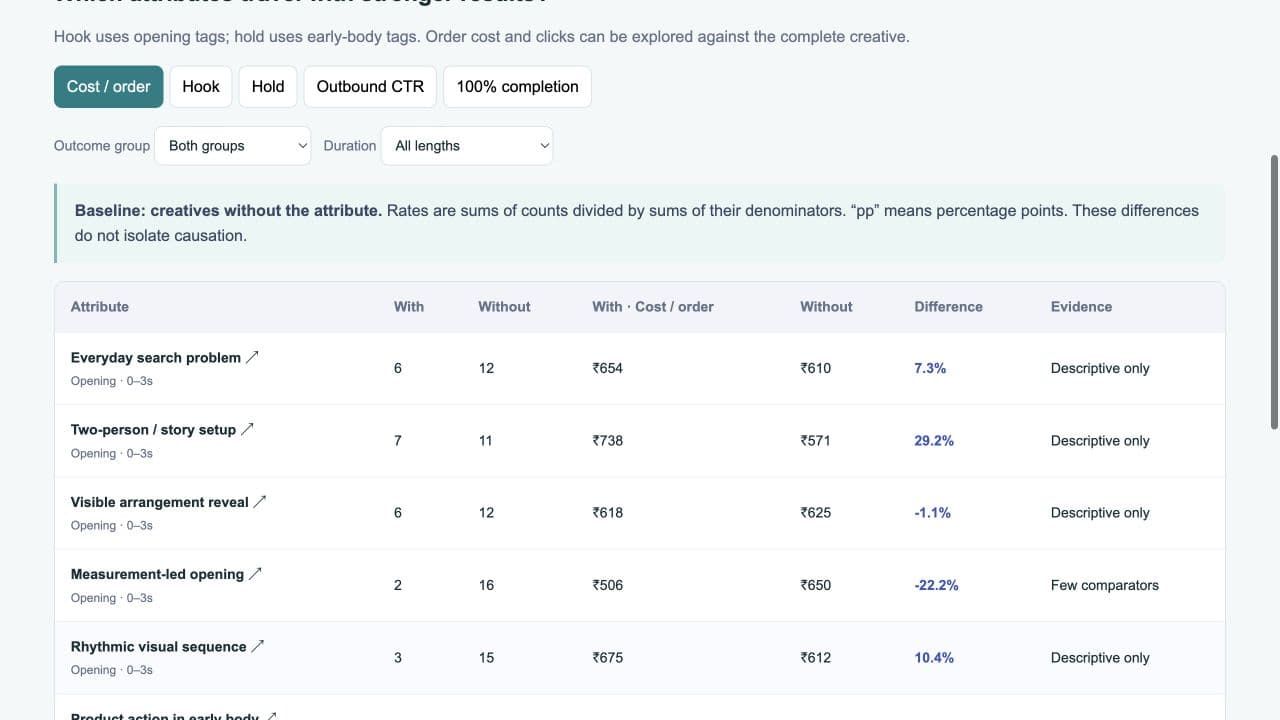 Inspect attribute comparisonsOpen report ↗
// from finding to decision
Keep the strongest supported message. Change the part that needs improvement.
The diagnosis points to a specific next creative test, with uncertainty stated when the evidence is thin.
01 / PATTERN
Efficient results, weak hook
The argument appears to work once people watch.
Preserve the argument. Test a different opening.
02 / PATTERN
Strong hook, weak hold
The opening attracts attention, but the body loses it.
Preserve the opening. Revise the body sequence.
03 / PATTERN
Strong attention, weak results
People watch, but the sales argument may not convert.
Inspect the proof, offer and CTA.
// broaden the options
Bring in competitor concepts and trending formats.
Public ads can reveal alternate hooks, visual formats, proof devices and storytelling sequences. Trend references can suggest ways to package a message. Your own result data determines which message and elements deserve to be kept.
COMPETITOR CREATIVE
What else is being tried?
Break selected public ads into hook, format, proof and sequence. Adapt useful ideas into a new execution for your brand.
YOUR CAMPAIGN EVIDENCE
What has earned its place?
Use your own comparable results to choose what to retain and set the control for the next test.
Competitor concept analysis is planned. Trend references provide creative inspiration; they do not carry measured competitor performance. Browse the industry trends →
// production-ready storyboard
The concept becomes a brief your team can shoot.
Every storyboard connects the creative choice to its supporting observation, then sets out timed visuals, proposed dialogue, proof, CTA and the test condition.
The Foldwell example preserves the supported product argument and tests a different opening while keeping the rest of the ad comparable.
Foldwell · synthetic example
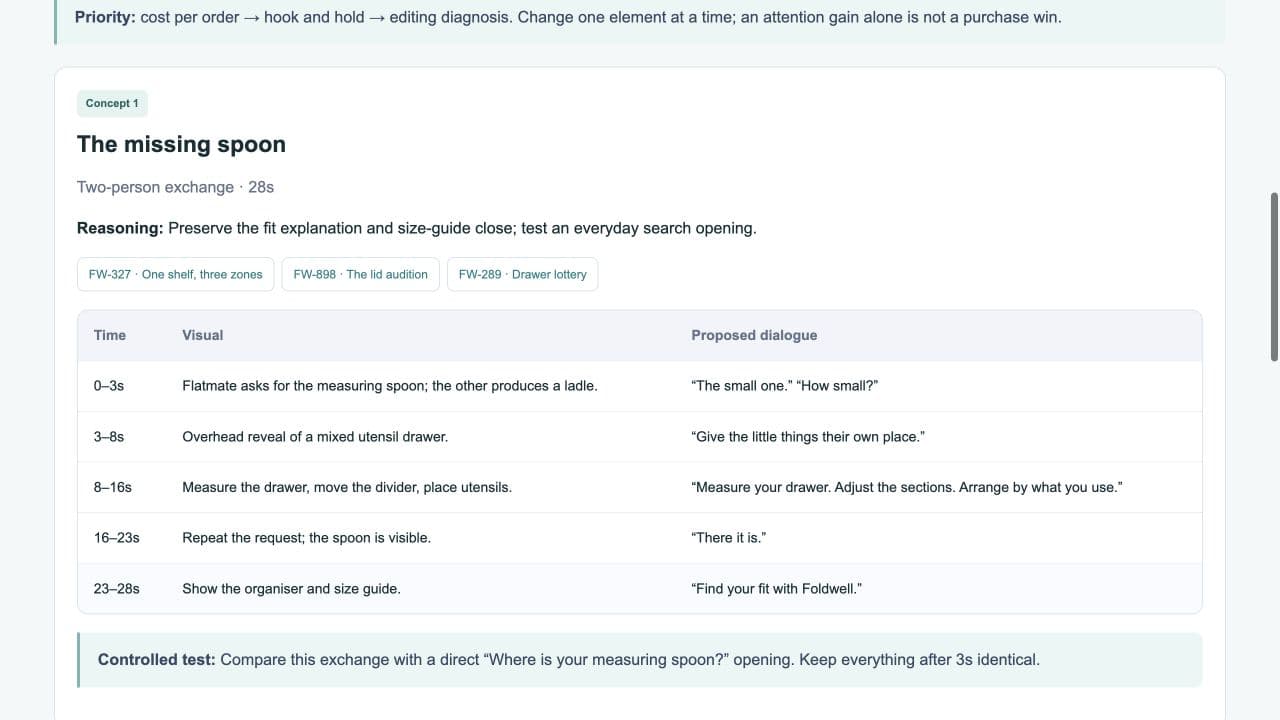 Open the storyboard briefOpen report ↗
// what your team receives
A creative production plan sized to your account.
Ready-to-produce concepts and storyboards with hooks, dialogue, visual direction, proof and CTA, backed by inspectable attribute comparisons, creative references and transcripts. Scope follows your creative volume and production needs.
THE OUTPUT
From evidence to next test
- ✓Creative diagnosis and priorities
- ✓Concepts with a reason for each direction
- ✓Timed storyboards for production
- ✓Test conditions so you can learn what worked