Can Claude Tell If Your Meta Creative Is Fatiguing?
Can Claude detect creative fatigue?
Yes. Point Claude at a Meta ad account through the Ads MCP and it will read every fatigue signal there is — rising CPM, sliding CTR, frequency creeping up, hook and hold rates decaying week over week. AI creative fatigue detection works, and it works well. The one catch is that an AI answers the exact question you asked with the exact context you gave it. Ask "when should I refresh?" without stating your objective and it may reach for a common, generic benchmark — in one session it suggested monitoring to a frequency of 4-5, which is a branding number, whereas a performance account is already fatiguing past roughly 2.5 to 3. That's the prompt being underspecified, not the tool being broken. Give it your objective and your kill thresholds and it becomes a sharp, consistent monitor.
The rest of this post is that framework: what each metric is actually measuring, what fatigue looks like across all of them, and how to specify the objective so the answer lands on your economics — plus the two matrices that make the refresh call. If you want the wider picture of what the tooling can and can't do, start with the Meta Ads MCP pillar.
First, what each metric is actually FOR
Fatigue diagnosis falls apart when you stare at one number in isolation. The trick is to treat your cost per result as a chain and read it in order. The identity that holds it together:
Cost per Result = CPM ÷ 1000 ÷ CTR ÷ CVR
Read left to right, that's: what it costs to be seen, then whether the creative earns the click, then whether the click becomes a result. Diagnose in that order and you never confuse a media problem with a creative one. Hook rate and hold rate then sit underneath CTR, explaining why the click is or isn't happening on video.
CPM — cost to be seen (media & audience)
CPM is what you pay to put 1,000 impressions in front of people. It's owned by your media and your audience, not directly by the ad — but a fatiguing creative drags it up anyway, because Meta's auction charges you more to keep forcing a stale ad on a saturated audience.
CTR — earning the click (the creative's honest signal)
CTR is the creative's most honest report card: of the people who saw it, how many tapped. When targeting is stable and CTR falls, the creative is losing its pull. This is the number to weight most heavily for fatigue.
CVR — click to result (landing & offer)
CVR is clicks that became results. It lives on your landing page and your offer, not the ad. If CVR is the thing that moved, refreshing creative is wasted effort — the leak is downstream.
Hook rate — did they stop (3s-plays ÷ impressions)
Hook rate is 3-second video plays divided by impressions: did the first frame stop the thumb. Above ~30% is strong, 15–30% is workable, under 15% means the creative is effectively invisible in the feed.
Hold rate — did they stay (ThruPlays ÷ 3s-views)
Hold rate is ThruPlays divided by 3-second views: of the people you stopped, how many stayed. The shape of the drop-off names the fix — an early cliff is a broken promise, a slow bleed is a slow middle.
| Metric | What it measures | Owned by | What moves it |
|---|---|---|---|
| CPM | Cost to reach 1,000 | Media & audience | Narrow/premium audience, seasonality, weak creative, frequency saturation |
| CTR | Who tapped, of those who saw | The creative | Hook/first 3s, offer clarity, creative-audience match, thumb-stop |
| CVR | Who converted, of clicks | Landing & offer | Page speed/clarity, promise-match, price |
| Hook rate | Did the first frame stop them | The creative | ≥30% strong, 15–30% ok, <15% invisible |
| Hold rate | Did they stay to a ThruPlay | The creative | Drop-off shape names the fix |
What creative fatigue looks like across these
Fatigue rarely shows up as one dramatic number. It's a pattern: the audience hasn't changed, but it costs more to reach and fewer people respond. Here's how to read it without being fooled.
Rising CPM on a stable audience = fatigue, not targeting
If your audience definition hasn't moved and CPM is climbing, you're not looking at a targeting problem — you're looking at the auction penalising a creative it has shown too many times. This is the cleanest early signal of when to refresh ad creative: CPM ticking up while the ad set is untouched. Pair it with a softening CTR and the diagnosis is settled.
Why frequency alone lies to you
Frequency is seductive because it's a single tidy number, and it lies constantly. A frequency of 3 on a fresh, high-CTR creative is fine. A frequency of 2 on a creative whose hook rate has already collapsed is not. Frequency measures exposure, not fatigue — it tells you how often, never how tired. Use it as a supporting signal behind CPM and CTR, never as the trigger on its own.
Why the answer depends on the objective you give it
Here's a concrete moment from a live session. Running against a real account, we asked Claude when to refresh the creative — without stating the campaign objective. It suggested monitoring until a frequency of 4-5. That's a perfectly good ad frequency threshold for branding: reach and awareness campaigns genuinely run to 4-5 before diminishing returns, because repetition is the goal. For a performance or direct-response objective, a frequency past roughly 2.5 to 3 is already fatigue. The answer wasn't a malfunction — it was the correct answer to an underspecified question. Asked "when should I refresh?" with no objective attached, an AI reaches for the most common published benchmark, and most published frequency guidance is written for brand campaigns.
That's the whole lesson about claude meta creative analysis. The data work is exact — its hook rate and hold rate math was right to the decimal. What it can't do is invent the standard to judge the data against, because a standard is a business decision that lives in your head, not in the API. Supply it and everything downstream snaps to your economics.
The fix: give it your objective + kill threshold in the prompt
The fix costs you one sentence. State the objective and the kill line: "This is a performance account optimising for purchases. Treat frequency above 2.5 as fatigue, flag any ad whose CTR has dropped more than 20% week-over-week, and rank refresh candidates by CPM trend." Now every judgement is anchored to your numbers instead of a generic average, and it stays anchored across every ad and every week. The same discipline applies when you let it manage a whole ad account with Claude — you supply the standards, it supplies the labour and the consistency.
The two matrices that make the call
Once the thresholds are set, the actual refresh decision comes down to two 2×2s. They're deliberately small — you could build a full decision tree, but a marketer mid-week doesn't need a flowchart, they need to know which lever broke. The first crosses CTR against CPM to locate the problem.
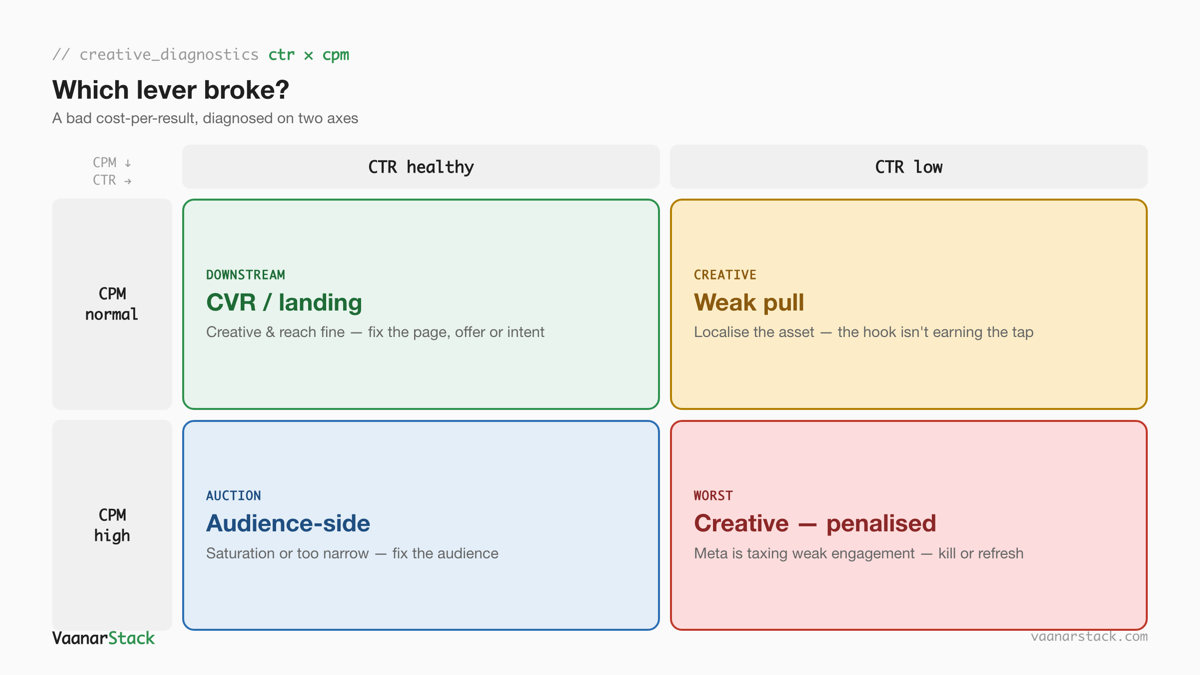
The second matrix only matters for video, and it tells you where the video breaks. Cross hook rate against hold rate: a weak hook with a strong hold means your first three seconds are wrong but the body works; a strong hook with a weak hold means the opening oversold and the middle can't keep them; weak on both means the concept is dead, not the edit.
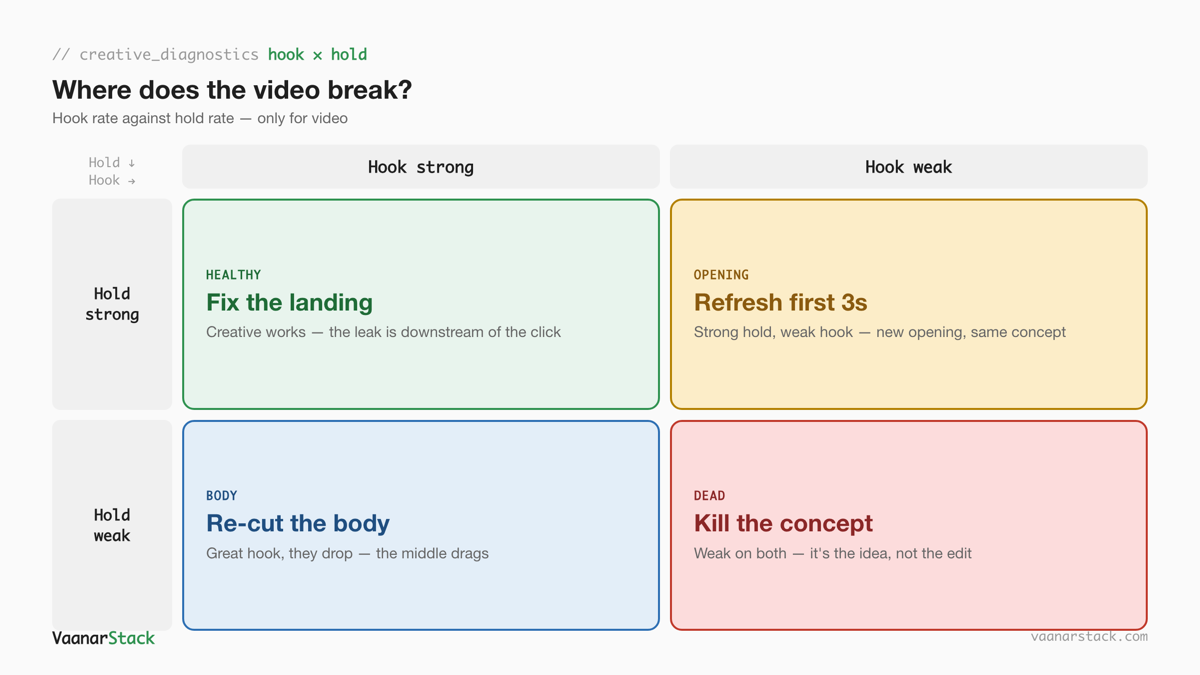
Two 2×2s, not the full tree. Claude can populate both from the account data in seconds — the value you add is telling it which quadrant means "refresh" and which means "leave it alone" for your objective.
So can you trust it to tell you when to refresh?
Yes — as long as you brief it like you'd brief a sharp analyst.
Yes as a monitor with your framework
Give Claude the framework — objective set, kill thresholds set, the two matrices as its rubric — and it's excellent. It never gets bored, never misses a week, computes hook and hold across every ad in the account faster than you'd open one report, and it applies your standard the same way every time. The only thing it can't supply is the standard itself: ask "is this fatiguing?" with no objective and you'll get a reasonable generic benchmark rather than your number. The tool is sharp; you own the definition of "too tired." It's the same discipline as when the MCP quietly gets location targeting wrong — it does exactly what you specified, so specify well.
We audit Meta creative for exactly this — the fatigue call, the CPM/CTR/CVR decomposition, and the hook/hold read on every ad in the account. If you'd rather have the framework applied for you, /audit/meta-ads.
Frequently asked questions
Can Claude tell me when to refresh my ad creative?
Yes, as long as you give it your objective and a kill threshold. It reads every fatigue signal accurately — CPM trend, CTR decay, hook and hold rates. What it can't do is guess your economics, so state the objective and the threshold in the prompt and it becomes a reliable, consistent refresh monitor.
What ad frequency counts as fatigue?
It depends on your objective. For a performance or direct-response campaign, a frequency past roughly 2.5 to 3 is already fatigue. For a branding or reach campaign, 4-5 is normal because repetition is the goal. Frequency alone is a weak signal anyway — read it behind rising CPM and falling CTR, not on its own.
Why did Claude say frequency 4-5 was fine?
In that one session the objective wasn't specified, so it reached for a common published benchmark — and most frequency guidance is written for brand campaigns, where 4-5 genuinely is the threshold. It was the right answer to an underspecified question. State a performance objective and it uses your number instead.
What creative signals should I actually watch?
Watch CPM on a stable audience (rising = fatigue), CTR week-over-week (falling = the creative is losing pull), and for video, hook rate (did the first frame stop them) and hold rate (did they stay). Diagnose in the order CPM → CTR → CVR so you never mistake a landing-page leak for a tired creative.
FAQ
Can Claude tell me when to refresh my ad creative?
Yes, as long as you give it your objective and a kill threshold. It reads every fatigue signal accurately — CPM trend, CTR decay, hook and hold rates. What it can't do is guess your economics, so state the objective and the threshold in the prompt and it becomes a reliable, consistent refresh monitor.
What ad frequency counts as fatigue?
It depends on your objective. For a performance or direct-response campaign, a frequency past roughly 2.5 to 3 is already fatigue. For a branding or reach campaign, 4-5 is normal because repetition is the goal. Frequency alone is a weak signal anyway — read it behind rising CPM and falling CTR, not on its own.
Why did Claude say frequency 4-5 was fine?
In that one session the objective wasn't specified, so it reached for a common published benchmark — and most frequency guidance is written for brand campaigns, where 4-5 genuinely is the threshold. It was the right answer to an underspecified question. State a performance objective and it uses your number instead.
What creative signals should I actually watch?
Watch CPM on a stable audience (rising = fatigue), CTR week-over-week (falling = the creative is losing pull), and for video, hook rate (did the first frame stop them) and hold rate (did they stay). Diagnose in the order CPM → CTR → CVR so you never mistake a landing-page leak for a tired creative.
