Claude vs ChatGPT vs Codex for Meta Ads (2026): Does the Model Actually Matter?
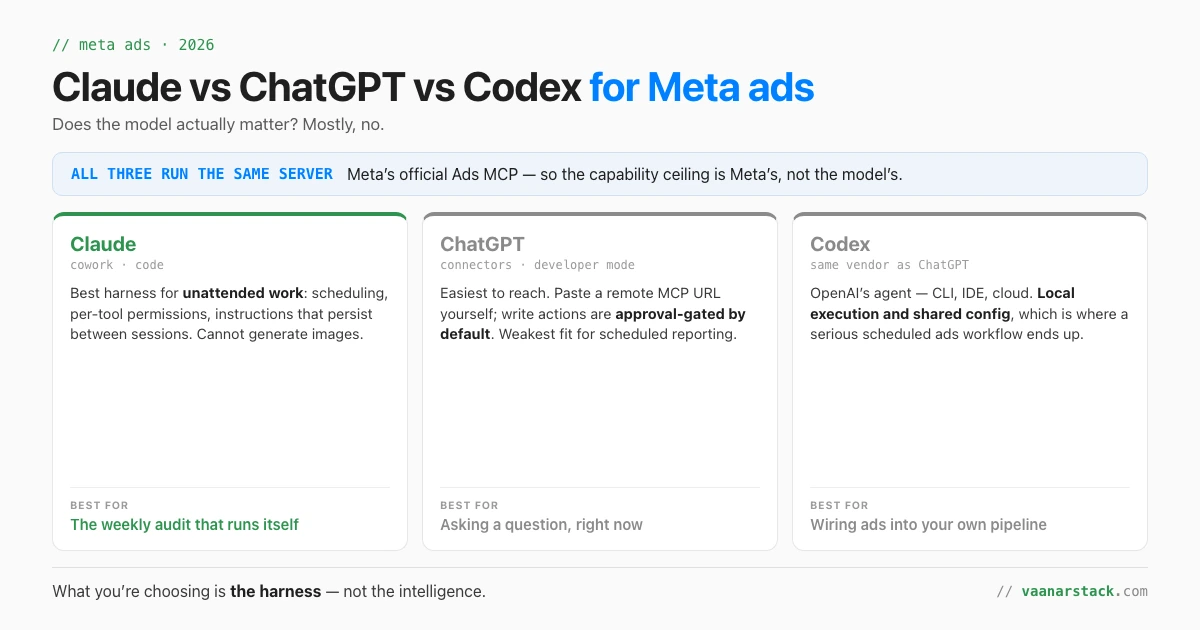
Mostly the wrong question. Claude, ChatGPT and Codex all run the same official Meta Ads MCP server, so what the AI can do to your ad account is set by Meta's tool list, not by the model. Swapping models does not unlock a capability, and it does not close one off. What actually differs is the harness around the model — whether it can run on a schedule without you, whether it remembers your framework between sessions, how finely you can gate writes against reads, and what stops it doing something expensive. That is what you are choosing between.
Is Claude or ChatGPT better for Meta ads?
For the analysis itself, the difference is smaller than the marketing suggests. Both are capable of reading an ad account and reasoning about it well. The decision that actually changes your outcomes is where the work runs, not which model runs it — and that is a property of the client application, not the model weights.
First, a naming problem: ChatGPT and Codex are the same vendor
Worth clearing up before the comparison, because the title implies three separate products and that is not quite the shape of it.
Codex is OpenAI's agent; ChatGPT is where most people meet it
Codex is OpenAI's agentic coding system. It runs as a CLI, as an IDE extension for VS Code and JetBrains, as a cloud agent reachable from inside ChatGPT, and as a GitHub bot. ChatGPT is the consumer and work surface. They are not two competing products from two companies — they are one vendor's two front doors, and you can reach Codex from within ChatGPT.
Both support MCP, but not the same way
This is the difference that matters in practice.
| ChatGPT | Codex | |
|---|---|---|
| How you add a server | OpenAI-maintained connectors for popular services, plus developer mode where you paste a remote MCP server's HTTPS URL yourself | Configured in the CLI or the IDE extension, with the config shared between them |
| Transports | SSE and Streamable HTTP | Local and remote servers |
| Write actions | Gated behind an approval prompt by default | Governed by your own config and environment |
| Where it runs | OpenAI's surface | Your machine, your IDE, or their cloud |
They have also converged: OpenAI's app directory became a shared plugin directory across ChatGPT and Codex on 9 July 2026. So the gap between "the ChatGPT setup" and "the Codex setup" is narrowing, and it is narrowing toward the Codex end.
Why this post says "ChatGPT"
Because that is what people search for. But if you are building a scheduled, unattended ads workflow rather than asking a one-off question, the OpenAI tool you actually end up in is Codex — the CLI or the IDE extension, not the chat window. Worth saying plainly rather than letting the title imply otherwise.
The part that is identical: the MCP server
Every one of these clients connects to the same thing.
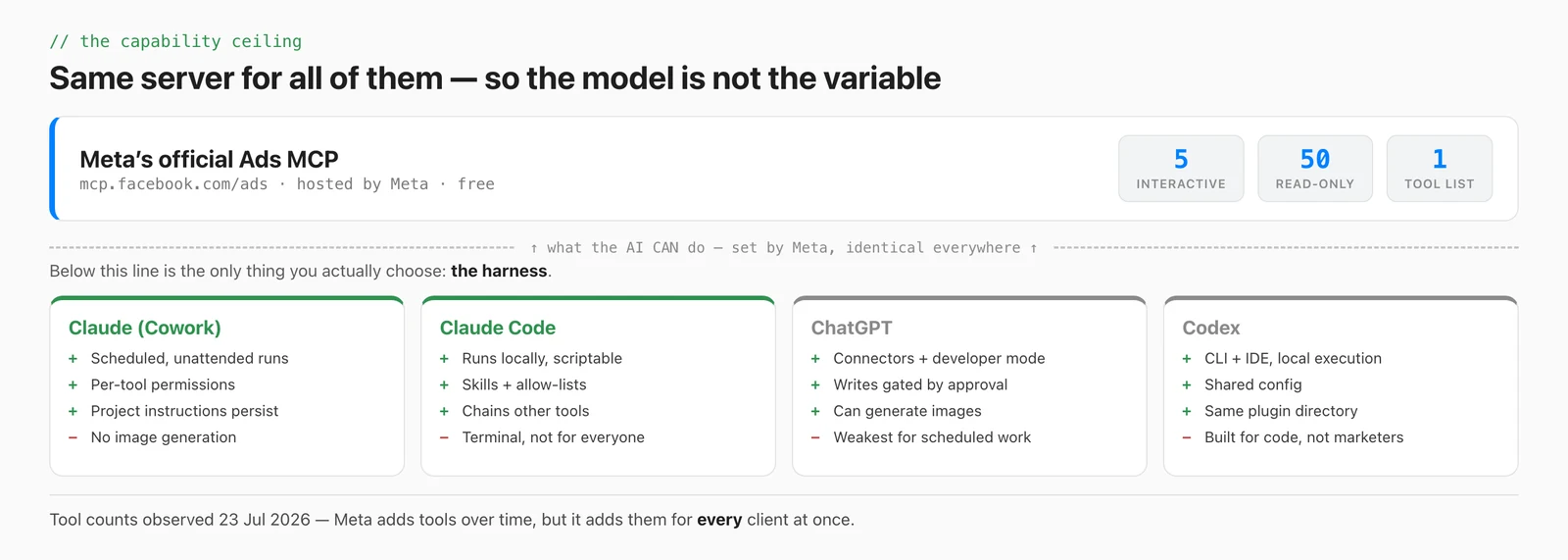
One hosted connector, many clients
Meta's official Ads MCP is a hosted server at a URL Meta runs, it is free, and it launched in April 2026. You do not install it or maintain it. Any MCP-capable client can connect to it, which today includes Claude, ChatGPT, Codex, Cursor and Gemini. The same tools, the same names, the same arguments, the same responses.
So the capability ceiling is Meta's, not the model's
If a tool does not exist in Meta's list, no model can perform that action — not through better prompting, not with a larger context window, not on a newer release. And when Meta adds a tool, every client gets it at once. This is the single most useful thing to understand before comparing AI tools for ads work: you are not choosing capabilities, you are choosing how the capabilities are operated. What that tool list does and does not contain is covered in the Meta Ads MCP capability guide.
What actually differs: the harness
The harness is everything wrapped around the model: how it is invoked, what it remembers, what it is allowed to do without asking, and what happens when nobody is watching.
| Harness feature | Claude (Cowork / Desktop) | Claude Code | ChatGPT | Codex |
|---|---|---|---|---|
| Scheduled, unattended runs | Yes | Yes, via your own scheduler | Weak | Yes, it is a CLI |
| Instructions persisting between sessions | Project instructions | Instruction files in the repo | Custom instructions and projects | Config files |
| Permission granularity | Per-tool, per-connector | Per-tool allow-lists | Approval prompt on writes | Your config and sandbox |
| Local execution | No | Yes | No | Yes |
| Chaining to other tools and files | Connectors | Anything on your machine | Connectors | Anything on your machine |
Can it run on a schedule without you?
This is the question that decides whether an ads workflow is a demo or a system, and it comes down to one setting most people never open.
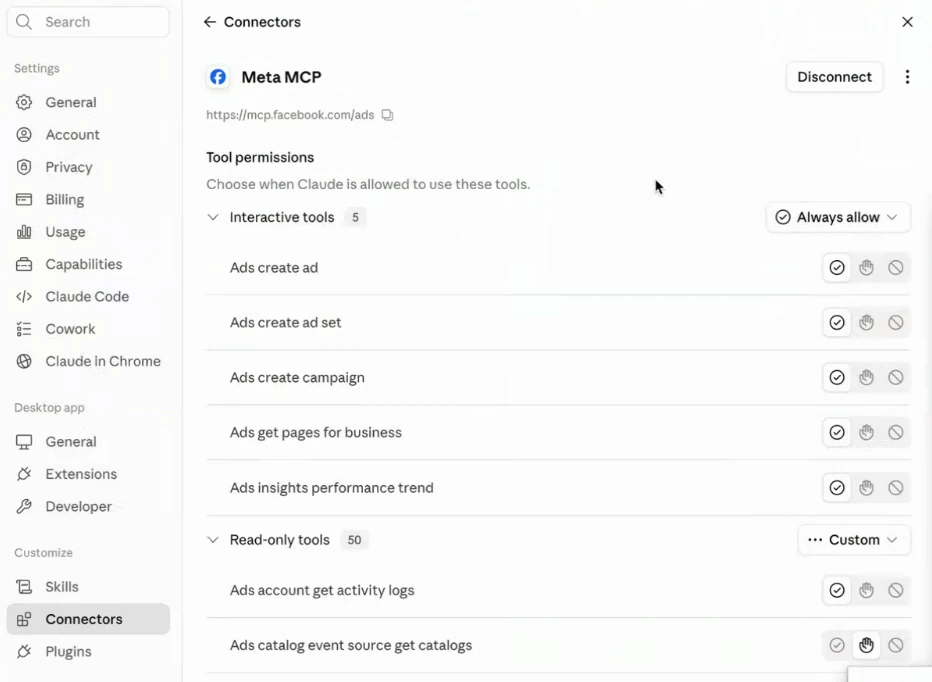
The connector's permission panel, from our July walkthrough. Note the split: the tools are grouped into interactive and read-only, with a separate permission control for each group.
The configuration that makes unattended work possible is to set the read-only group to Always allow and leave anything that writes on a prompt. If reads require approval, the run stops at the first tool call and waits for a human — which means a scheduled 7am audit simply does not happen. If writes are set to always allow, you have handed an unattended process your budget. The whole of "can this run by itself, safely" lives in that one distinction.
ChatGPT gates write actions behind approval by default, which is the right default and also the reason it is the weakest fit for scheduled reporting: the approval model is built around a human being present.
Does it remember your framework between sessions?
An audit is only comparable month to month if it applies the same rules each time. That means the framework — what gets checked, the thresholds, the account-level exceptions — has to live somewhere the tool reads every run, not in the prompt you happened to type. All four support some version of this; what differs is whether it is a text box in a settings panel or a file in your repo that you can version and review.
Kill switches: what stops it doing something expensive
Ask this before you connect anything to a live ad account. Per-tool permissions are the first layer. Read-only access at the platform level is the second and much stronger one — on Google Ads the official MCP is read-only by construction, and on Meta you can grant an analyst-level role rather than an advertiser one. Where the boundary sits in practice is the subject of what an AI assistant can and cannot manage in an ad account.
Model differences that are real
Three that are worth knowing, having established that most claimed differences are not.
Claude cannot generate images
Not a limitation of the connector — the model does not do image generation at all. If your workflow is "analyse the account, then produce the next creative", that is a genuine, citable gap, and ChatGPT covers it. If your workflow is analysis and reporting, it never comes up.
Long-context analysis vs speed
Ad-account work produces large, repetitive payloads: months of daily rows across dozens of entities. How much of that a model can hold and reason over in one pass changes how you have to structure the job — a big context lets you ask one question over the whole export, a smaller one forces you to aggregate first. Both approaches work. One takes more plumbing.
How each behaves when the framework is vague
This is the difference that costs real money, and it is not a model difference at all. A sloppy framework produces hallucinated confidence in every model we have tested. Ask "how are my ads doing?" and you get a fluent answer built on whichever numbers came back first. Ask "compute cost per result by campaign for the last 8 complete weeks, flag anything more than 30% above its own trailing median, and tell me what you could not retrieve" and every model gets it broadly right. The framework beats the model, consistently and by a wide margin.
Can Codex use the Meta Ads MCP?
Yes — how to add an MCP server to Codex
Codex supports MCP servers configured through the CLI or the IDE extension, with the configuration shared between the two. You add Meta's hosted server by its URL and authenticate the same way you would anywhere else — the server does not know or care which client is calling it. Because Codex runs locally, it can also do the things a chat surface cannot: write the results to a file, commit them, trigger the next step in a pipeline, or run on a cron.
The connection step itself is identical in shape to connecting Meta Ads to Claude — a hosted URL and an OAuth grant.
Which is safer to give account access to?
Compare permission models, not brand trust
"Which company do you trust" is the wrong axis, because in every case the connection runs on your credentials against your ad account, and you can revoke it. The useful comparison is what each client lets you switch off:
- ChatGPT gates write actions behind an approval prompt by default. Safe out of the box, and awkward to automate.
- Claude splits tools into groups with separate permission controls, so you can free the reads and keep every write on a prompt. This is the combination that makes a safe scheduled audit possible.
- Codex inherits whatever your config and sandbox allow — the most control and the most rope.
Whichever you pick, do the platform-level thing as well: grant the least-privileged role that still lets the tool read what it needs. A connector permission you can toggle is a good second line of defence, not the first.
Is one cheaper for daily ad reporting?
Where the token cost actually goes
The connector is free on both sides — Meta does not charge for the MCP server. Your cost is model usage, and for ads work that cost is dominated by payload size, not by which model you chose. A daily report pulling 90 days of ad-level data across a large account moves far more tokens than the same question against a pre-aggregated summary. Two levers matter, and neither is the price list: request narrower date ranges and fewer fields, and aggregate before you reason rather than after. Get those right and the difference between vendors is noise; get them wrong and no pricing tier saves you.
Should you use more than one?
Most teams doing this seriously end up with two, split by job rather than by preference.
| The job | What we would use | Why |
|---|---|---|
| Scheduled weekly or daily audit | Claude (Cowork) or Codex | Runs unattended; read-only tools can be freed without freeing writes |
| One-off "why did CPA move?" | Whichever is already open | A single interactive question — the harness is irrelevant |
| Building the audit framework itself | Claude Code or Codex | The framework is a file. It should be versioned, diffed and reviewed like code |
| Generating the next creative | ChatGPT | Image generation, which Claude does not do |
| Anything that writes to a live account | Whichever, with writes on a prompt | The setting matters far more than the vendor |
If the MCP does the work, what are you choosing between?
The harness. That is the whole answer.
The tools are Meta's. The account is yours. The model is close to interchangeable for the analysis itself. What is left — and it is not a small residue, it is the entire difference between a party trick and a system — is whether the thing runs on a schedule, remembers your standards, can be told exactly what it may and may not touch, and stops safely when it is unsure.
So the question to ask a vendor is not "which model is best at Meta ads". It is: can I run this every Monday at 7am, with reads allowed and writes blocked, against a framework I wrote down and can review? The answers to that differ a lot. The answers to "which model" mostly do not.
We run the framework, not the demo — a fixed-scope paid audit with the checks, the weights and the reasoning written down. See how the Meta ads audit works.
Frequently asked questions
Is Claude or ChatGPT better for Meta ads?
For the analysis itself they are close, because both run the same official Meta Ads MCP server and the capability ceiling is set by Meta's tool list rather than by the model. Claude has the stronger harness for unattended, scheduled work — per-tool permissions and instructions that persist. ChatGPT is easier to reach and can generate images, which Claude cannot.
Does the Meta Ads MCP work the same in ChatGPT and Claude?
Yes. It is one hosted server run by Meta, so the tools, their names and their responses are identical whichever client connects. What differs is how you add it — ChatGPT uses connectors or developer mode where you paste the URL, Claude adds it as a connector — and how permissions are then managed.
Can Codex use the Meta Ads MCP too?
Yes. Codex supports MCP servers configured through its CLI or IDE extension, with config shared between them, and OpenAI's plugin directory has been shared across ChatGPT and Codex since 9 July 2026. Because Codex runs locally it can also write results to files and run on a schedule.
Which model is better at analysing ad performance?
Less than people expect, and far less than the framework you give it. A vague question produces confident, unreliable answers from every model; a specific one with named metrics, a defined window and an instruction to report what it could not retrieve produces good answers from all of them. Spend your effort on the framework, not the model choice.
Can Claude generate ad images?
No. Claude does not do image generation at all, which is a genuine gap if your workflow ends in producing creative. ChatGPT covers that. For analysis, reporting and auditing it never comes up.
Which one is safer to give account access to?
Compare permission models rather than brands, since in every case the connection uses your own credentials and can be revoked. ChatGPT gates writes behind an approval prompt by default. Claude splits tools into groups so you can allow reads and keep writes prompted. Codex inherits your config, giving the most control and the most rope. Whichever you choose, also grant the least-privileged role at the ad platform itself.
Is one cheaper to run for daily ad reporting?
The connector is free either way — Meta does not charge for it. Your cost is model usage, and that is driven by payload size far more than by vendor pricing. Narrow the date range, request fewer fields, and aggregate before reasoning; do that and the vendor difference is noise.
What is a "harness" and why does it matter more than the model?
The harness is everything around the model: how it is invoked, what it remembers between sessions, what it may do without asking, and what stops it. It matters more because the model's capabilities against your ad account are already fixed by Meta's tool list — so the harness is the only part of the setup you actually control, and it is what decides whether the work can run unattended and safely.
FAQ
Is Claude or ChatGPT better for Meta ads?
For the analysis itself they are close, because both run the same official Meta Ads MCP server and the capability ceiling is set by Meta's tool list rather than by the model. Claude has the stronger harness for unattended, scheduled work - per-tool permissions and instructions that persist. ChatGPT is easier to reach and can generate images, which Claude cannot.
Does the Meta Ads MCP work the same in ChatGPT and Claude?
Yes. It is one hosted server run by Meta, so the tools, their names and their responses are identical whichever client connects. What differs is how you add it - ChatGPT uses connectors or developer mode where you paste the URL, Claude adds it as a connector - and how permissions are then managed.
Can Codex use the Meta Ads MCP too?
Yes. Codex supports MCP servers configured through its CLI or IDE extension, with config shared between them, and OpenAI's plugin directory has been shared across ChatGPT and Codex since 9 July 2026. Because Codex runs locally it can also write results to files and run on a schedule.
Which model is better at analysing ad performance?
Less than people expect, and far less than the framework you give it. A vague question produces confident, unreliable answers from every model; a specific one with named metrics, a defined window and an instruction to report what it could not retrieve produces good answers from all of them. Spend your effort on the framework, not the model choice.
Can Claude generate ad images?
No. Claude does not do image generation at all, which is a genuine gap if your workflow ends in producing creative. ChatGPT covers that. For analysis, reporting and auditing it never comes up.
Which one is safer to give account access to?
Compare permission models rather than brands, since in every case the connection uses your own credentials and can be revoked. ChatGPT gates writes behind an approval prompt by default. Claude splits tools into groups so you can allow reads and keep writes prompted. Codex inherits your config, giving the most control and the most rope. Whichever you choose, also grant the least-privileged role at the ad platform itself.
Is one cheaper to run for daily ad reporting?
The connector is free either way - Meta does not charge for it. Your cost is model usage, and that is driven by payload size far more than by vendor pricing. Narrow the date range, request fewer fields, and aggregate before reasoning; do that and the vendor difference is noise.
What is a 'harness' and why does it matter more than the model?
The harness is everything around the model: how it is invoked, what it remembers between sessions, what it may do without asking, and what stops it. It matters more because the model's capabilities against your ad account are already fixed by Meta's tool list - so the harness is the only part of the setup you actually control, and it is what decides whether the work can run unattended and safely.
