Can Claude Manage My Whole Ad Account, or Only Analyse It?
Can Claude manage my whole ad account?
Yes — and it can do far more than analyse. If you want to manage an ad account with Claude, the model can read your account, recommend changes, draft them, and — on the right connector — execute writes: pause an ad set, edit a budget, launch a campaign. But "manage the account" only holds inside a harness you have built and tested against your own objectives, with guardrails and kill switches. Turned loose without one, Claude will confidently make changes it cannot verify, and report success either way. So the real question isn't "can it run my ad account" — it's "have you built the harness that decides what it's allowed to touch."
What exactly is a harness?
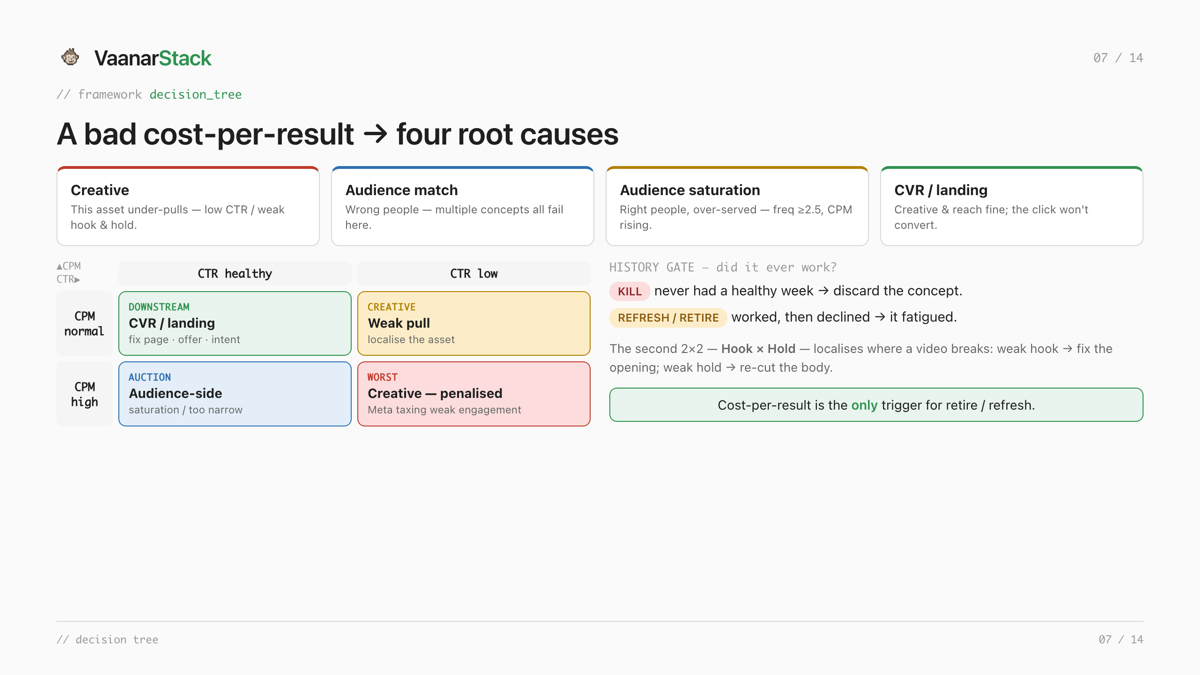
A harness is the framework you hand Claude so it analyses and acts consistently against YOUR objectives instead of improvising each time. It's the metrics that matter for your account, the thresholds that separate good from bad, the decision rules that turn a number into an action, the guardrails on what it may touch, and the stop conditions that halt everything. It is not code and it is not a piece of software — it's your judgment, written down, so the model applies it the same way every run. That's the whole trick: a capable model becomes a reliable one the moment it's working inside your framework instead of guessing at one.
Here's a real one we built — the decision tree Claude runs on every ad to turn a bad cost-per-result into a specific root cause.
Hand the model that framework and point it at the account, and it produces the same decisive output every week — every ad sorted into one action.
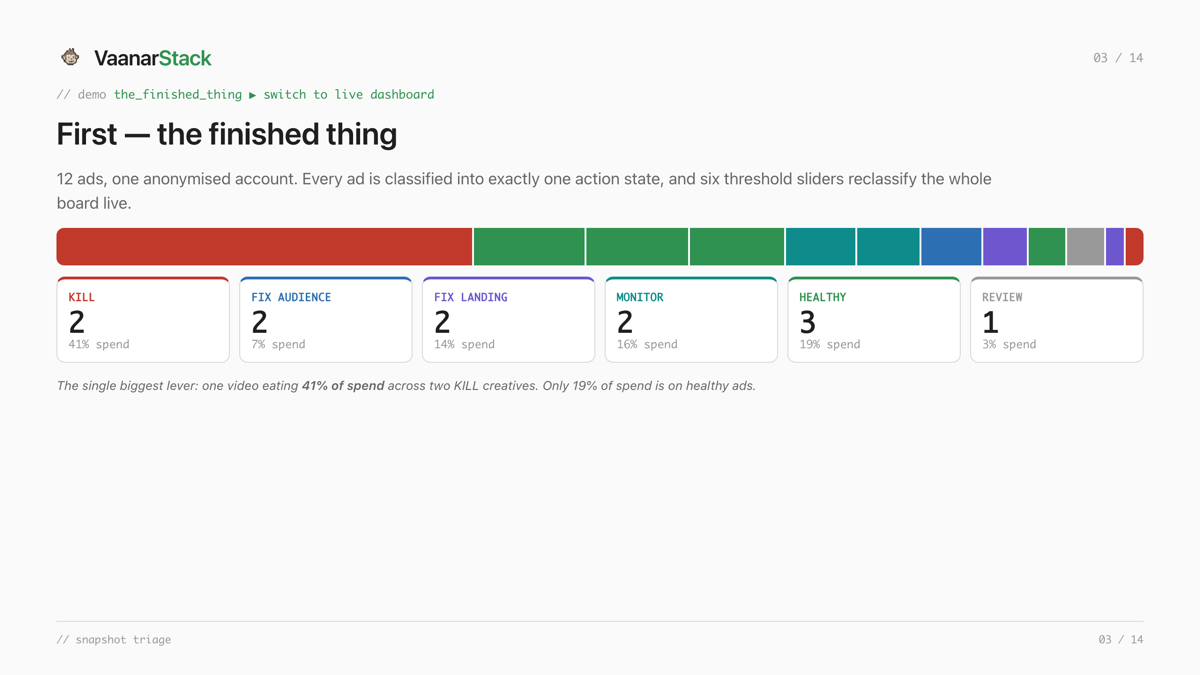
That is a creative-analysis harness — it decides what's wrong, it doesn't change anything. Managing a whole account means an analysis harness like this plus a write harness — caps, an allowlist, and a kill switch — for anything that actually changes the account.
What "manage the account" actually breaks into
"Managing the account" is not one capability. It's six, and they carry very different risk. Split them out before you decide what to automate:
- Analyse — pull spend, CPA, ROAS, frequency, and tell you what's happening.
- Recommend — turn that read into "cut this ad set, scale that one."
- Draft changes — write the exact edit as a proposed action, unexecuted.
- Execute writes — actually push the change to the platform.
- Verify — confirm the write landed the way it was intended.
- Monitor over time — watch the account across days and catch drift.
Don't read this as "the first three are safe and the last three are risky." Analysis has its own failure mode: unharnessed, Claude hands you a decisive-sounding root cause that's wrong. It uses generic thresholds instead of your account's, can't see your change log or the context behind a spike, and states the wrong answer with the same confidence as the right one. A confident wrong read is how you make a bad write. Every stage needs governing.
Every stage needs a harness — analysis included
Analysis is only as good as the framework and context you hand the model. Give it no thresholds and it invents them; give it no change log and it guesses at causes. So the read side is not "safe by default" — it's the stage where a wrong answer is most likely to go unnoticed, because nothing executed and nothing errored. The rest of the loop is only as trustworthy as the analysis it's built on, which is why the harness has to span all six stages, not just the ones that write.
The harness: guardrails and kill switches
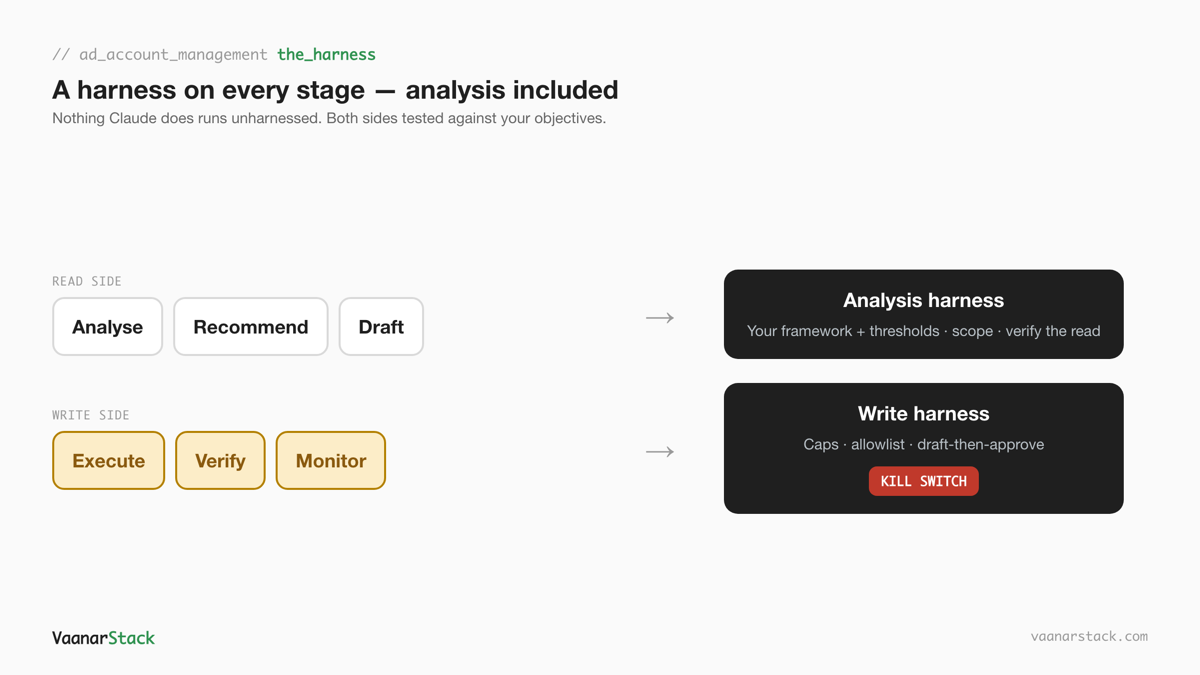
A harness is the set of rules, limits, and stop conditions that sit between Claude's output and your live account. It's what turns "an AI that can technically edit campaigns" into "an AI you'd let near a real budget" — and, just as importantly, "an AI whose read you'd act on." Building it is the whole job. There are no meaningful ai ad account management limits until you write them down — the model has no default sense of what a healthy CPA is for your account or how much spend is too much to move. You need two flavours, both tested against your own objectives.
The analysis harness — your framework, scoped context, and a verified read
The read side gets its own harness. Give the model YOUR framework — your CPA targets, your fatigue thresholds, your definition of underperformance — so it judges against your account, not a generic average. Scope what it can look at: which accounts, which date ranges, and the change log and context it needs to reason about a spike instead of guessing. Then verify the read before you act on it — never trust a single confident answer; ask it to show the numbers behind the call and sanity-check them yourself. Analysis is only as good as the framework and context you hand it.
The write harness — caps, an allowlist, draft-then-approve, and a kill switch
The write side is stricter, because now real budget moves. It needs per-action caps (no budget move over X%), an allowlist of what may be touched (pause an ad set, yes; delete a campaign, no), a mandatory draft-then-approve step so a human sees every write before it fires, and a kill switch. Don't build one claude ads automation framework and reuse the analysis version here — the write side carries the irreversible risk and needs the harder guardrails.
Kill switches and kill criteria — written down BEFORE you let it write
A kill switch is the ability to stop everything instantly — and, more importantly, the pre-written conditions that trigger it. Decide the kill criteria before the first automated write, not during the incident: pause all automation if spend moves more than a set amount in an hour, if CPA doubles, if the model tries an action outside its allowlist, or if a verify step fails. Write them as thresholds, not vibes. A kill switch you have to think about mid-panic is not a kill switch.
Test the harness against YOUR objectives before you trust it
A harness copied from a blog post is a guess. Test yours against your own account's objectives on low stakes first — a small campaign, a throwaway budget — and watch what it actually does versus what you meant. The guardrails that matter are specific to your CPA target, your spend levels, and your risk tolerance. Until you've watched it run inside the harness and caught it doing something you didn't intend, you haven't tested it — you've hoped.
Write access differs by platform — this decides what's even possible
Before any of this, one hard constraint: whether Claude can write at all depends entirely on the connector, and the two big platforms differ. This isn't a harness question — it's a "is the door even open" question.
Meta's official MCP reads AND writes — it can do all of it
Meta's official Ads MCP is a hosted connector that reads and writes. It can pull insights, create campaigns, edit budgets, pause ad sets — the full loop. On Meta, the "can it" is settled; every constraint that's left is one you impose through the harness.
Google's official MCP is read-only — you need a vetted community MCP to write
Google's official Ads MCP is read-only by design — three tools, all reads, no writes. That's a deliberate choice, not a bug (why the Google MCP is read-only). To write to Google Ads you either build against the Google Ads API directly — which means going through its PRD approval process — or run a vetted community MCP that exposes write tools. "Vetted" is load-bearing: a community connector with write access to your ad budget is a thing you audit before you trust.
| Platform | Read | Write | How |
|---|---|---|---|
| Meta official MCP | Yes | Yes | Hosted connector |
| Google official MCP | Yes | No — read-only by design | Self-hosted, 3 tools |
| Google via API / community MCP | Yes | Yes, with approval / vetting | Google Ads API + PRD approval, or a vetted community MCP |
The failure modes a good harness catches
Here's why the harness isn't optional. These are real, repeatable ways the model fails — and each maps to a specific guardrail.
It can't verify its own writes — put a verify step in the harness
Claude will tell you a change succeeded when it didn't. Ask it "did that update actually go through?" and it often can't tell — it reports the intent, not the result. The guardrail is an explicit verify step: after every write, read the state back from the platform (not from the model's memory) and confirm it matches. If you can't verify, treat the write as failed.
It defaults to the wrong thresholds — feed it your framework
Ask Claude whether a creative is fatigued and it will pick a threshold out of the air — usually the wrong one for your account (the wrong-threshold problem on creative fatigue). It has no idea what "high frequency" means for your funnel. The fix is to feed it your framework: your CPA targets, your fatigue rules, your definition of underperformance. Don't let it improvise the numbers that decide spend.
It sets targeting it can't confirm — supply the IDs
When Claude writes targeting, it can set a location it cannot verify — you ask for Delhi and it quietly adds somewhere you never named (the location-targeting failure). The guardrail is to supply exact IDs rather than letting it resolve place names, and to verify the resulting audience in Ads Manager before the campaign spends. For the full picture of what each connector can and can't do, see the Meta Ads MCP pillar and the Google Ads MCP pillar.
None of this means don't automate. It means automate inside a harness you've tested. We build exactly this harness as an audit plus automation setup — /audit/meta-ads.
Frequently asked questions
Can I run my ad account entirely through Claude?
Technically, on Meta, yes — the official connector can read, write, and execute the full loop, and on Google you can add write access through the API or a vetted community MCP. But "entirely through Claude" with no human in the loop is the version that goes wrong. Claude can't reliably verify its own writes, so the workable version is Claude drafting and monitoring inside a harness while a human approves the writes that move real money.
Is AI ad-account management just hype?
No — it genuinely does more than analyse, including creating and editing campaigns on the right connector. The hype isn't in the capability, it's in the framing that you can hand over the account and walk away. The capability is real; the autonomy isn't. It works when you've built and tested the guardrails and kill switches, and it fails when you haven't.
What can Claude safely automate in ads?
The read-heavy work: analysis, anomaly spotting, pulling reports, drafting recommended changes, and monitoring for drift against thresholds you defined. On the write side, safely automate only the narrow, capped, reversible actions inside an allowlist — with a mandatory verify step and a kill switch. Anything that can spend big or can't be undone stays behind a human approval.
What should a human still control?
The kill criteria, the spend caps, and the final approval on any write that moves meaningful budget or can't be reversed. The human owns the objectives the harness is tested against, sets the thresholds Claude uses instead of the model's guessed defaults, and verifies critical changes in Ads Manager. Claude proposes and monitors; the human decides what actually ships.
FAQ
Can I run my ad account entirely through Claude?
Technically, on Meta, yes — the official connector can read, write, and execute the full loop, and on Google you can add write access through the API or a vetted community MCP. But "entirely through Claude" with no human in the loop is the version that goes wrong. Claude can't reliably verify its own writes, so the workable version is Claude drafting and monitoring inside a harness while a human approves the writes that move real money.
Is AI ad-account management just hype?
No — it genuinely does more than analyse, including creating and editing campaigns on the right connector. The hype isn't in the capability, it's in the framing that you can hand over the account and walk away. The capability is real; the autonomy isn't. It works when you've built and tested the guardrails and kill switches, and it fails when you haven't.
What can Claude safely automate in ads?
The read-heavy work: analysis, anomaly spotting, pulling reports, drafting recommended changes, and monitoring for drift against thresholds you defined. On the write side, safely automate only the narrow, capped, reversible actions inside an allowlist — with a mandatory verify step and a kill switch. Anything that can spend big or can't be undone stays behind a human approval.
What should a human still control?
The kill criteria, the spend caps, and the final approval on any write that moves meaningful budget or can't be reversed. The human owns the objectives the harness is tested against, sets the thresholds Claude uses instead of the model's guessed defaults, and verifies critical changes in Ads Manager. Claude proposes and monitors; the human decides what actually ships.
